Kiya Learning Online Social Science Classes
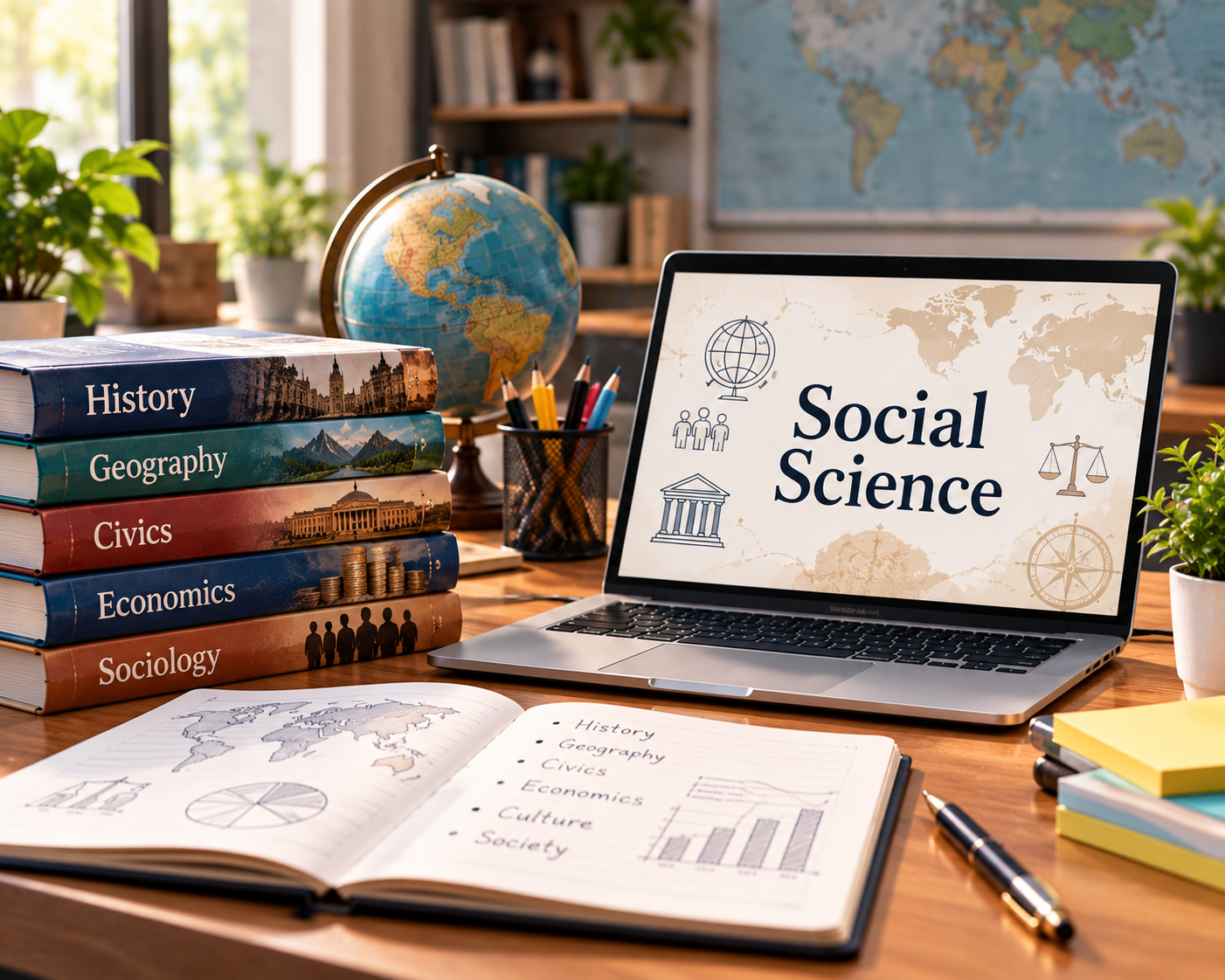
In Social Science, we teach students about the people, societies, cultures, countries, governments, economics, and history of their world. Through studying a number of key areas of the curriculum (History, Geography, Civics, Economics, and Sociology), this course encourages students to make connections between what they learn in the classroom.
Kiya Learning allows learners to access the subject matter in Social Science to attain quality education for academic, professional, or personal success. Our comprehensive curriculums offer all rounded coverage for children’s specific goals. Professional-Guidance provide strategized learning that contributes to students’ knowledge.

Why Choose Kiya Learning for Social Science Classes?
In Social Science, we teach students about the people, societies, cultures, countries, governments, economics, and history of their world. Through studying a number of key areas of the curriculum (History, Geography, Civics, Economics, and Sociology), this course encourages students to make connections between what they learn in the classroom.
Expert Social Science Instructors
Our certified tutors provide students with the competitive knowledge required for the coming generations. They are industry-based trainers and are efficient in providing excellent education to aspiring students.
Personalized Learning
Each and every student joins us with an agenda, so we make sure each student has a personalized study planner on the basis of his/her aims and skills so that they can easily manage consuming education at their own pace.
Interactive Online Learning
Our 1-to-1 interactive sessions give students access to doubt clarification and comfortable communication with the mentors. This process boosts learning with crystal-clear concepts and provides critical thinking abilities.
Flexible Scheduling
We offer rescheduling to enable learners to have flexibility with the timing of the sessions. We make sure that the students come in for the session with no stress on their minds. Focusing totally on in-depth learning fosters growth.
School Curriculum and Grades
Courses are perfectly aligned with the school framework to boost curriculum-focused education. As it is aligned with the school curriculum, we can easily fit it in with the classroom teachings & reinforce it in the learning process. The online social science course gives students a more in-depth understanding of the subject, complementing the school syllabus and providing them with the edge they require.
Why Should Students Learn Social Science?
Science encourages students to ask questions, examine evidence, recognise patterns and develop practical strategies for understanding and solving problems.
Elementary School
These lessons, stories, visuals, and real-world applications serve to give students the basis of History, Geography, Civics, and society by allowing them to become observers on their journey while sparking curiosity.
Middle School
A more in-depth examination of the past, landforms, government, societies, customs, and economies helps students to deepen their understanding. They acquire the skills to analyze issues, interpret evidence, investigate, and form reasoned arguments supported by facts.
High School
Develop and refine analytical, research, and argument skills, and critically evaluate social and historical debates. Students gain the ability to analyse, synthesise information, understand, and compare contrasting opinions.
Explore Social Science Learning
Courses are designed around school frameworks, educational boards, curriculum expectations, student level and individual learning goals.
International and National Educational Boards
Kiya Learning online sessions on academic subjects, social science, are designed keeping in mind the major international and national educational boards' framework and their curriculum-based education.
International Baccalaureate (IB)
The syllabus has been developed carefully to reinforce the IB Educational Board Framework so that students are guided to move from memorizing facts towards achieving a greater understanding and appreciation of the subject matter.
Cambridge Assessment International Education (CAIE)
The course is formed for the CAIE-aligned curriculum and aims to strengthen knowledge and analytical skills through focused lessons covering key social science concepts, source analysis, interpretation, and examination-style practice.
- History
- Geography
- Civics
- Economics
- Sociology
- Source Analysis
- Evidence-Based Reasoning
- Exam Practice
Cambridge Assessment International Education (CAIE)
The course is formed for the CAIE-aligned curriculum and aims to strengthen knowledge and analytical skills through focused lessons covering key social science concepts, source analysis, interpretation, and examination-style practice.
IGCSE
The course syllabus is carefully designed for IGCSE-focused guidelines, providing students with a strong understanding of History, Geography, Economics, and other relevant areas through structured lessons, source-based questions, case studies, and exam-focused preparation.
GCSE
This covers a breadth of learning for GCSE exams, building strong knowledge and understanding of the subject. Skills for analysis, evaluation, writing, and evidence-based arguments are needed to perform successfully on exam day.
CBSE
Offer organized lessons structured around the CBSE social science curriculum, which spans History, Geography, Political Science & Economics through concept-based learning, revision, and exam practice.
- Historical Analysis
- Data & Evidence analysis
- Observation & Reading & Language Practice
- Economic Concepts
- Global Awareness
- Reading, Listening & Language Practice
- Graphs & data
- Scientific problem-solving
Other International Curricula
Revise the classes and also the reading material as per the syllabus prevailing in each of the State Boards so that the students are able to familiarize themselves with the subjects mentioned in the syllabus.
Other International Curricula
Deliver individualized Social Science tuition to students studying under international syllabuses. Lessons will be tailored to the syllabus, level, goal, and assessment for each individual. With targeted learning students strengthen their education for successful academics.
- Elementary School
- Chemical equations
- Scientific relationships
- Scientific Numericals
- High School & Scientific Concepts
- Data & Evidence
- Data & Evidence analysis
- Advanced scientific problem-solving
Social Science Academic Preparation
Learning Science involves more than remembering facts and formulas. Students develop reasoning, analytical, observational, research and problem-solving skills while engaging with scientific concepts.
Prepare Confidently for Social Science
We organize classes for structured PSLE Social Science preparation for students to reinforce subject knowledge. Tutors help learners approach exams with confidence through focused preparation for curriculum, question formats, exam structure, and essential language competencies.
Curriculum-Focused Learning
The lessons are designed to align specifically with the latest PSLE Social Science syllabus, giving learners thorough and systematic preparation in grammar, vocabulary, reading comprehension, written work, and communication skills.
Practice Papers & Test Preparation
Students learn through a variety of sample and revision questions, practice exams, and past exam papers. Regular practice increases awareness of exam question styles and improves answer accuracy.
Personalized Exam Guidance
Build confidence with scientific calculations, formulas, observations and practical applications.
Develop Social Science Skills
Science encourages students to understand relationships between concepts, recognise patterns, examine evidence and follow logical processes towards conclusions.
Through practical Science activities, students learn to investigate challenges systematically, compare evidence and improve their understanding step by step.
Turn Science Into Real-World Understanding
Science becomes more meaningful when students connect classroom concepts with experiments, everyday situations, natural events and real-world applications.
Critical Thinking
Students learn to examine information carefully, identify relevant facts, compare different sources, and distinguish between reliable evidence and unsupported claims. They are encouraged to question assumptions, recognize bias, consider multiple perspectives, and evaluate the validity of different arguments.
Analytical Skills
Students learn to question a range of social, historical, geographical, and political matters from various standpoints and how different kinds of people, communities, civilizations, countries, and historical periods may interpret or view the same matter from varying perspectives.
Research Skills
Understand that students can use skills to collect, identify, organize, and interpret information from relevant sources. Learn to verify that there are trustworthy sources and sources with evidence, fact vs opinion, and compare evidence from different sources.
What Will Your Child Learn?
Students explore important scientific concepts through structured lessons, practical activities, visual learning, problem-solving and curriculum-focused practice.
Evidence-Based Reasoning
Students develop the skill of substantiating their claims, ideas, or conclusions using appropriate facts, evidence, examples, or supporting data. They must actively analyze information and choose information that specifically supports their viewpoint.
ExploreEvaluation Skills
Students will learn to compare evidence from multiple sources, analyse conflicting accounts, and question the authority for the significance of evidence. They will be able to evaluate the purpose, the surrounding, and the authorship.
ExploreCreative Thinking
Students are able to investigate a variety of perspectives and to devise innovative strategies to understand social problems. They can examine the range of alternative solutions as well as the implications of an issue for various communities and individuals.
ExploreInternational and National Educational Boards
Build broad scientific understanding through age-appropriate life science, earth science and everyday science topics.
ExploreGlobal Awareness
Students gain knowledge of diverse cultures, communities, world phenomena, and global interrelationships between people, communities, cultures, economics, and environments, and how these shape each other.
ExploreReading, Listening & Language Practice
Learn to investigate questions, collect information, analyse data and organise knowledge systematically.
ExploreGrammar, Vocabulary & Comprehension
Read charts and graphs, understand experiments and interpret scientific information and results.
ExploreAnalytical Skills
Apply scientific principles, formulas, laws and logical reasoning to conceptual and numerical problems.
ExploreAnalytical Skills & Communication
Connect Science beyond textbooks with practical experiments, daily situations and real-world applications.
ExploreSkills Your Kid’s Acquire
Critical Thinking
Students learn to examine information carefully, identify relevant facts, compare different sources, and distinguish between reliable evidence and unsupported claims. They are encouraged to question assumptions, recognize bias, consider multiple perspectives, and evaluate the validity of different arguments.
Analytical Skills
Students learn to question a range of social, historical, geographical, and political matters from various standpoints and how different kinds of people, communities, civilizations, countries, and historical periods may interpret or view the same matter from varying perspectives.
Evidence-Based Reasoning
Analyzing Social Science texts and choosing proper words, phrases, and sentences stimulates logical thinking and analysis. Learners derive meaning from context, compare expressions, and choose appropriate language.
Evaluation Skills
Learn to interpret charts, graphs, experiments, observations and scientific data accurately.
Global Awareness
Students gain knowledge of diverse cultures, communities, world phenomena, and global interrelationships between people, communities, cultures, economics, and environments, and how these shape each other.
Regular Feedback
Feedback by mentors is about performance and really helps students in the learning process, as well as is very helpful in identifying students' areas of strength and weakness so that they can improve for better growth.
Why Choose Kiya Learning for Academic Excellence?
Develop Social Science Skills
Language skills can be effectively developed through well-organized, structured Social Science lessons, where students learn and hone their ability to read, write, speak, and listen. They develop proficiency by enhancing grammatical awareness, building vocabulary, and improving intonation and pronunciation.
Global Awareness
Students develop Social Science proficiency by practising reading, writing, speaking, listening, grammar, vocabulary, and pronunciation through structured lessons and regular feedback.
Personalized Learning
Students build awareness of grammar, sentence structure, word meanings, expressions, context, and appropriate language usage through guided Social Science activities.
Interactive Online Learning
Students practise conversation, dialogue, role-play, pronunciation, listening, and writing so they can communicate their ideas more clearly in Social Science.
A Structured Approach to Science Education
Kiya Learning provides structured, engaging and accessible Science tuition for learners from Primary to Grade 12, with personalised support and curriculum-aligned learning.
const student = "scientifically confident" ;
const skills = [
"scientific reasoning" ,
"scientific problem solving" ,
"critical thinking"
];
supportScienceStudent(student);
Online Science Classes FAQs
Find answers to common questions about Kiya Learning Science tuition.
Give Your Child the Confidence to Observe & Solve
Explore structured Science tuition designed to build strong concepts, scientific reasoning, analytical thinking, observation skills and exam readiness from Primary to Grade 12.